Kampong Gelam does not announce itself with fanfare. You turn off a busy road, step under the shade of an old shophouse arcade, and the city suddenly feels different. The call to prayer drifts across rooftops. A spice merchant weighs out oud resin behind a glass counter. A woman in a floral baju kurung waves you in from her doorway. This is one of Singapore’s most layered neighbourhoods, and a single well-planned day here will leave you with memories that outlast any museum ticket or shopping receipt.
Your Day at a Glance
One day in Kampong Gelam covers centuries of living heritage, one of Singapore’s most distinctive shopping streets, and a dining scene that punches well above its weight.
- Begin at the Sultan Mosque and Malay Heritage Centre to ground yourself in the history that gives this neighbourhood its identity.
- Spend the afternoon on Arab Street and surrounding lanes, where textile traders, basket weavers, and artisan perfumers share the same block they have occupied for generations.
- Close the day with dinner on Haji Lane, where street murals, strong coffee, and eclectic menus make for an evening that feels distinctly Singaporean.
Why Kampong Gelam Repays Real Attention
Most visitors who pass through expecting a colourful backdrop for photographs find themselves lingering longer than planned. The neighbourhood has that effect. It carries genuine historical weight without turning it into performance.
Kampong Gelam was designated a settlement for the Malay community by Stamford Raffles in the early 19th century. Sultan Hussein Shah, who had signed the treaty ceding Singapore to the British, was given land here, and the royal compound shaped the area around it. Arab, Bugis, Javanese, and Indian traders followed, each leaving a mark on the architecture, the food, and the goods sold along these streets.
That layered past is not just decorative. The perfumers on Arab Street trace their craft to traders who arrived from Yemen and the Arabian Peninsula generations ago. The textile merchants know their fabrics. The old mosques and shophouses are still in daily use. Come with that in mind, and every street corner carries a little more meaning.
Morning at the Sultan Mosque: The Best Place to Begin
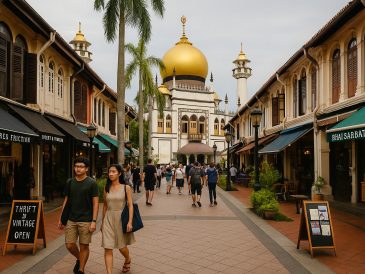
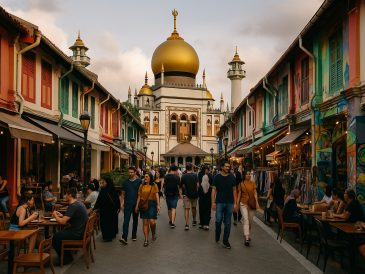
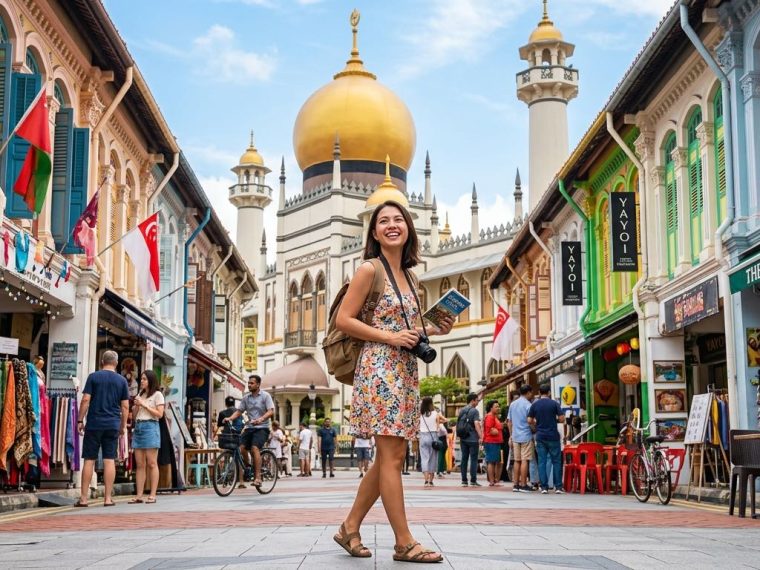
The Sultan Mosque on North Bridge Road anchors the whole district. Its gold dome is visible from several blocks away, and there is something genuinely arresting about watching it rise above the low shophouse rooftops as you approach from Bugis MRT.
The current building was completed in 1928, designed by Irish architect Denis Santry in a style that blends Saracenic and Moorish elements. It replaced an earlier mosque on the same site, partly funded by the East India Company as part of the original treaty with Sultan Hussein Shah. The mosque was gazetted as a national monument in 1975 and remains an active place of worship to this day.
Non-Muslim visitors are welcome outside of prayer times. Loaned robes are available at the entrance if needed. Dress modestly regardless. Take your time in the courtyard rather than rushing in and out. Look closely at the base of the main dome. It is ringed with glass bottles, said to honour poorer community members who donated what they could during construction. The bottles are real, whatever weight you choose to give the story.
Arriving by 9am gives you the best experience. The light is good, the tour groups have not yet arrived, and the neighbourhood around the mosque has a calm that it loses by mid-morning.
The Malay Heritage Centre: Where the Context Clicks Into Place
Five minutes on foot from the mosque, the Malay Heritage Centre sits within the former Istana Kampong Gelam, the royal palace compound of the Malay sultans. The main structure dates to the 1840s. It was converted into a museum and opened to the public in 2005 after a careful restoration.
Plan for at least 90 minutes here. The permanent galleries cover the maritime trading networks that brought different communities to this coastline, the performing arts traditions of the Malay world, daily life in the kampong as it existed within living memory, and the contributions of the Malay community to Singapore’s modern development. The curators have made strong choices throughout. This museum does not reduce its subject to folklore.
The gallery on Bugis sea traders is particularly worth your time. The Bugis were among the most formidable maritime traders in the region, sailing from Sulawesi to ports across the Indian Ocean and South China Sea. Their presence in Singapore was not incidental. Understanding that changes how you read the neighbourhood around you.
The courtyard garden is a good spot to rest after the galleries. Admission is affordable, and there is a cafe on the grounds if you need a coffee before heading out into the afternoon heat.
Opening Hours and Entry Fees for Key Stops
| Attraction | Opening Hours | Entry Fee (SGD) |
|---|---|---|
| Sultan Mosque (visitors) | Sat, Thu 10am, 12pm, 2pm, 4pm; Fri 2:30pm, 4pm | Free |
| Malay Heritage Centre | Tue, Sun 10am, 6pm (closed Mondays) | $6 adult / $4 concession |
| Arab Street shops | Most open daily, 10am, 7pm | Free to browse |
| Haji Lane dining | Cafes from 11am; restaurants from 5pm, 6pm | Free to enter |
Arab Street in the Afternoon: Textiles, Oud, and the Long Tradition of Trading
Arab Street runs between North Bridge Road and Beach Road, flanked on both sides by two and three-storey shophouses that have housed traders of one kind or another for close to two centuries. The afternoon is the right time to be here. The heat of midday has eased, the shops are fully open, and the street moves at an unhurried pace that rewards browsing.
Three things stand out on Arab Street specifically:
- Textiles: Several long-running traders carry batik, songket, silk, and lace. Machine-printed batik is affordable and practical. Hand-blocked or hand-drawn batik is something else entirely. Ask to see both, and ask about the difference. The shopkeepers here know their stock and are generally happy to explain.
- Artisan perfumes: The concentrated oud and attar perfumes sold along Arab Street are unlike anything in a department store. They are built for warm skin, where they develop and deepen over hours rather than minutes. Try a sample on your wrist, wait ten minutes, then decide. The best of these perfumes are genuinely worth the money.
- Rattan and baskets: A handful of old-school traders still operate here, selling hand-woven rattan goods and practical baskets. These are useful objects made with real craft. A well-made rattan tray is more interesting at home than most souvenirs, and takes up almost no luggage space.
Take a detour down Bussorah Street when you are done on Arab Street. The pedestrianised stretch leads directly toward the Sultan Mosque dome, framing the view beautifully. It is lined with cafes and heritage shophouses and earns its reputation as one of the most photographed streets in the district.
The Oud Tradition: What Sets This Neighbourhood’s Perfume Culture Apart
The perfume trade here runs deeper than retail. Oud, derived from the resinous wood of infected agarwood trees, was traded across the Indian Ocean long before it entered Western fine fragrance. The Arab merchants who settled in Kampong Gelam brought with them both the materials and the sensibility. Fragrance in this tradition is personal, often spiritual, and approached with real seriousness.
Several family-run perfumers on Arab Street have been blending their own formulas for decades. They source materials from the Arabian Peninsula, South Asia, and Southeast Asia. Even if you do not intend to buy anything, spending fifteen minutes in one of these shops is one of the more distinctive sensory experiences Singapore has to offer. There is nothing quite like it elsewhere in the city.
Getting Through the Day Without Losing Your Bearings
The logistics are straightforward. Here is the order that works best for a first visit:
- Take the MRT to Bugis station on the East-West or Downtown Line. The Sultan Mosque is a ten-minute walk from Exit B.
- Spend the morning at the Sultan Mosque, then walk to the Malay Heritage Centre. Allow two to three hours in total for both.
- Have a light lunch at one of the cafes on Bussorah Street or near the museum before the afternoon stretch.
- Walk Arab Street and the surrounding lanes from around 1pm to 4pm. Two to three hours here feels comfortable rather than rushed.
- Head to Haji Lane by 5pm or 6pm, before the main dinner crowd settles in.
The whole district is walkable. Wear comfortable shoes. The sheltered arcade walkways of the shophouses are your best cover from the afternoon rain that sweeps through Singapore on most days.
Haji Lane at Dusk: A Different Kind of Energy
Haji Lane sits a short walk from Arab Street and occupies a different register entirely. It is narrow, barely wide enough for two people to pass with shopping bags in hand. Murals cover most of the wall space between shopfronts. The cafes and restaurants here cater to a younger, more eclectic crowd. The contrast with the more traditionally oriented end of the neighbourhood feels deliberate and earned.
The food choices are genuinely wide. Turkish meze, modern Malay plates, Japanese-influenced small dishes, and straightforward Singaporean coffee shops all sit within a few hundred metres of each other. There is no single correct order. The point is the street itself and the way the past and present share space without either crowding the other out.
A few practical notes before you sit down:
- Most restaurants on Haji Lane do not take reservations for small groups. Arriving before 6pm avoids the main dinner rush and makes it easier to get a seat outside, which is the better option as the evening cools slightly.
- The lane is largely halal-certified throughout. Many establishments are fully halal, which is worth knowing if it matters for your group. Menus are clearly labelled.
- The street art here changes periodically. Artists regularly add new work over old pieces. What is on the walls today will be different in a year, which keeps the lane from feeling like a static attraction.
Thinking Beyond the District: Where Singapore Fits in the Wider Region
Kampong Gelam is worth a full day on its own. But Singapore itself is often the starting point for a longer journey through the region, and that is worth planning ahead for. Little India is a twenty-minute walk away. Chinatown is a short MRT ride. Between the three heritage districts, you get a reasonably complete picture of how different communities built this city together over two centuries.
For those extending their trip beyond Singapore, the city sits at a convenient junction of air routes into Southeast Asia and beyond. Malaysia, Indonesia, Thailand, Vietnam, and the Philippines are all within a few hours by air. Travellers who want to build a coherent itinerary around Singapore and its neighbours will find that well-researched Asia travel guides offer the kind of regional context that individual city guides rarely provide. Knowing how Singapore connects to the broader landscape makes a multi-destination trip considerably easier to plan.
What a Day Here Actually Leaves You With
By the time you leave Haji Lane in the evening, you will have covered a great deal of ground without feeling as though you rushed anything. That balance is harder to achieve than it looks, and Kampong Gelam pulls it off because the neighbourhood is compact enough to walk in an afternoon but substantial enough to reward a full day.
The district has been through colonial administration, occupation during the Second World War, and the redevelopment pressure that reshaped most of Singapore’s older neighbourhoods in the decades following independence. It has come through all of that with its character largely intact. The traders are still there. The mosque still calls people to prayer five times a day. The shophouse arcades still shelter pedestrians from the rain.
A day in Kampong Gelam does not feel like a visit to a heritage zone preserved for visitors. It feels like a day in a neighbourhood that has kept on living its own life. The past and the present are both visible, neither has been tidied away for your comfort, and the result is a place that asks you to pay attention rather than simply take a photograph and move on.
That quality is rare. It is worth your day.